
Materials & Sourcing
Custom Metal Products:
A Buyer’s Guide
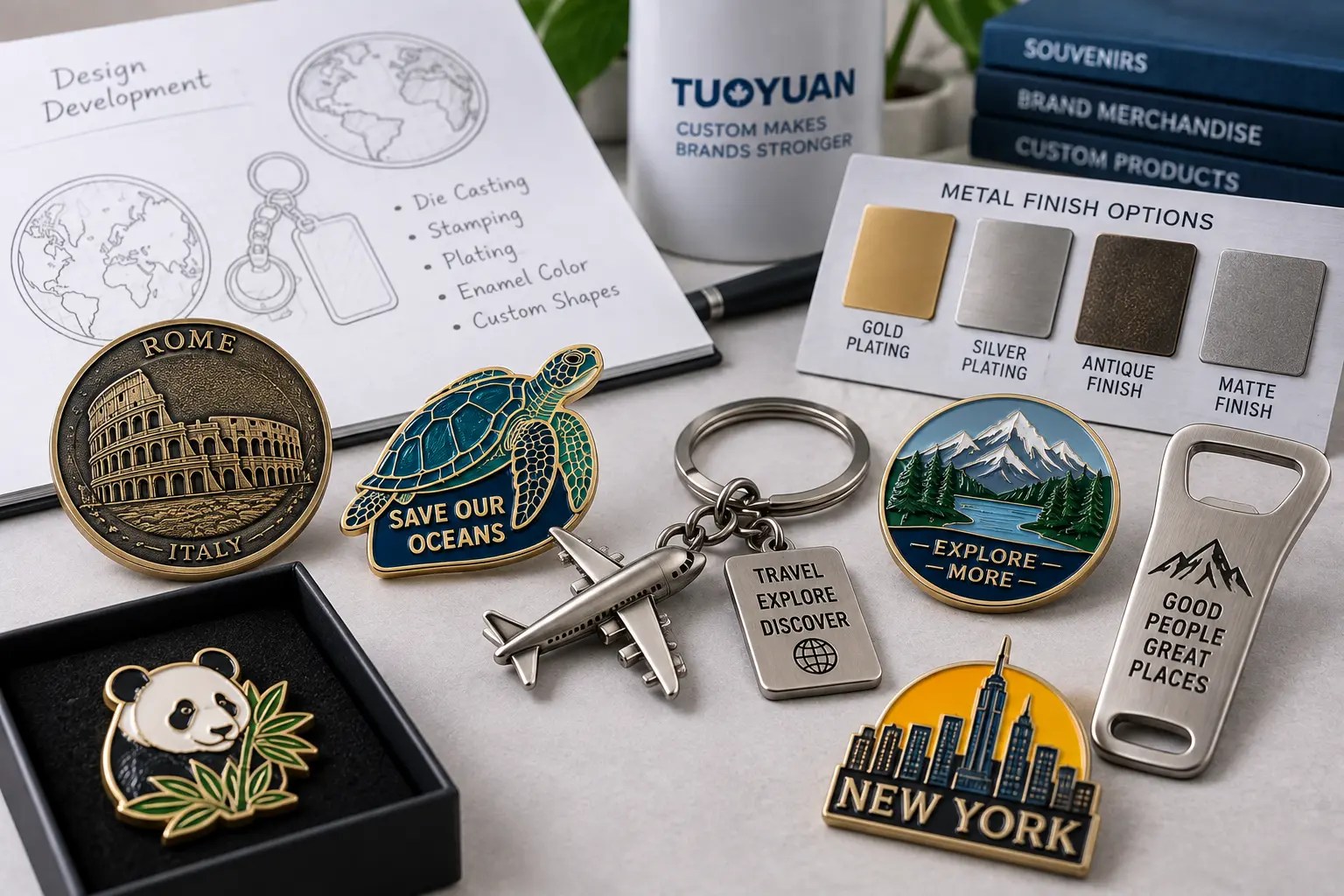
Metal is widely used for custom merchandise that requires dimensional relief, durable structure, plated finishes, enamel color and a more substantial premium feel. This guide explains how metal products should be designed, which production route may be appropriate, what buyers should specify and what should be reviewed before production.
What Is Custom Metal Merchandise?
Custom metal merchandise is commonly produced from zinc alloy or other suitable metal processes depending on product shape, relief, thickness, finish and function. Metal is especially useful for products that require durable structure, precise relief, plating, enamel decoration or functional hardware.
What Can We Make in Metal?
Six product families that account for most custom metal merchandise programs.


When Should You Choose Metal?
Metal is most useful when the product needs durable structure, crisp relief and a more substantial premium presentation.
Die Casting, Stamping or Other Routes?
Metal supports several production routes. The route should follow the design, thickness and function of the product.
Die Casting
Best for
- thicker products
- sculpted relief
- complex shapes
- integrated functional structures
Molten metal is formed in a mold, allowing dimensional shapes and deeper relief. Tooling, draft, thickness and surface finishing should be considered early. For a look at how a custom metal badge manufacturer runs hard enamel and zinc alloy die-casting in practice, see our factory process notes.
Stamping
Best for
- flatter products
- badges
- medallion-style pieces
- thinner structures
Metal sheet can be formed or stamped for flatter designs where the product does not require deep three-dimensional casting.
Other Processes
Best for
- specific structures
- mixed construction
- specialty hardware
Depending on the product, machining, cutting, engraving or mixed-process construction may be considered. The production route should follow the actual design rather than forcing every metal item into one process.
Design & Structure Considerations
Decisions made at the artwork stage are what keep tooling, finishing and assembly predictable later.
Relief Depth
Raised and recessed details should be balanced against overall thickness, readability and finishing requirements.
Minimum Detail Size
Very fine text, lines and narrow recessed areas should be reviewed before tooling to ensure they remain clear after casting, polishing, plating and color filling.
Thickness & Weight
Thickness affects strength, weight, perceived value and shipping cost. A heavier product is not automatically a better product.
Edge & Corner Design
Sharp edges, thin projections and exposed corners should be reviewed for production, polishing and handling.
Attachment Points
Key rings, pins, magnets, chains and functional hardware should be planned as part of the product structure.
Front & Back Design
Both sides should be confirmed before tooling, including logos, textures, recesses, branding and hardware placement.
Plating, Enamel & Surface Finishes
Metal appearance is produced through plating, polishing and color filling rather than through painted effects.
Polished Metal
Clean reflective finish used when a bright metallic appearance is required.
Antique Finish
Darkened recessed areas emphasize relief and give the product an aged or traditional character.
Gold-Tone Plating
Decorative plating used for warm premium appearance.
Silver / Nickel-Tone Plating
Suitable for cooler metallic presentation and high contrast with enamel colors.
Enamel Color
Color-filled recessed areas used for logos, graphics and branded designs.
Brushed / Matte Effect
Lower-reflection surface treatment for a more understated appearance.
How Metal Products Are Manufactured
A typical metal project moves through artwork preparation, tooling, forming or casting, trimming, polishing, plating or surface finishing, optional enamel or color application, assembly and final inspection. The exact route depends on product structure, material, finish, hardware and approved specification.
What Buyers Should Specify
Design Information
- Artwork or vector file
- Target dimensions
- Front and back design
- Relief direction
- Target thickness
- Plating direction
- Enamel / color requirements
- Attachment or functional hardware
Commercial & Market Information
- Estimated quantity per design
- Number of SKUs
- Destination market
- Intended user
- Packaging requirement
- Testing / compliance requirement
- Required arrival date
- NDA requirement where applicable
Open items
If some details have not yet been decided, identify them clearly so assumptions can be separated from confirmed project specifications.
Before quotation
Relief direction, target thickness, plating and enamel direction should be confirmed before tooling and sampling are scheduled.
Sample & Approval
Sampling is approved in four gates rather than treated as a single yes/no step.
ARTWORK
Dimensions, relief, text and front/back layout
STRUCTURE
Thickness, edge design, attachment points and hardware
FINISH
Plating, polishing, enamel and surface appearance
PACKAGING
Surface protection, fit and presentation
Sampling time depends on artwork, tooling route, relief complexity, plating, enamel, hardware, revisions and packaging requirements. Project timing should be confirmed against the final specification.
Packaging & Surface Protection
Metal products are rigid and durable, but polished, plated and enamel surfaces can still scratch, rub or mark during handling and transport.
Compliance & Destination Market
Compliance should be evaluated according to the finished product, base material, plating, coatings, intended user, destination market and required test scope. A report for one alloy, coating or sample should not be treated as universal approval for every finished product.
Before quotation, identify:
- Destination country or region
- Intended user
- Restricted-substance requirements
- Nickel / coating requirements where applicable
- Paint or enamel requirements
- Retailer or brand protocols
- Packaging and labeling requirements
One Collection, Multiple Materials
Metal in Multi-Material Collections
Metal does not need to be used for every product in a collection. A coordinated merchandise program may use metal for premium or functional items, soft PVC for flexible colorful products and polyresin for sculpted display pieces.
POLYRESIN
Sculpted & Hand-Painted
- Figurines
- Snow Globes
- Sculpted Display Pieces
SOFT PVC
Flexible & Colorful
- Keychains
- Magnets
- Luggage Tags
METAL
Premium & Functional
- Badges
- Coins
- Bottle Openers
Selected Applications


Frequently Asked Questions
What types of products are well suited to metal?+
Metal is well suited to badges, coins, keychains, bottle openers, souvenir magnets and other products that benefit from rigid structure, relief, plating or functional hardware.
What is the difference between die casting and stamping?+
Die casting is generally better suited to thicker or more dimensional shapes, while stamping is commonly used for flatter forms. The best route depends on design, thickness, relief and function. How that route choice changes tooling and unit cost is broken down in custom zinc alloy tooling and unit cost factors.
What plating options are available?+
Metal products can use different decorative plating directions, including bright, antique, matte or other approved effects depending on the project specification.
Can metal products include enamel color?+
Yes. Enamel or other color-filling methods can be used in recessed areas when the design requires colored logos, graphics or decorative elements.
Can metal be combined with soft PVC or other materials?+
Yes. Metal hardware or bodies can be combined with soft PVC, magnets or other components when the structure is designed for reliable assembly.
What information is needed before quotation?+
Buyers should provide artwork, dimensions, target thickness, relief direction, plating or color requirements, quantity, hardware, packaging, destination market and any compliance requirements.
Before You Request a Quote
- Artwork / vector file
- Product dimensions
- Front & back design
- Relief direction
- Target thickness
- Plating direction
- Enamel / color requirements
- Attachment / function
- Quantity
- Packaging
- Testing / compliance
- Destination
- Required arrival date
Ready to Start Your Custom Metal Project?
Send your artwork, target dimensions, quantity, plating direction, relief requirements, hardware and packaging needs. Our team can review the structure, identify production risks and confirm the information required before sampling and quotation.