
Materials & Processes
Custom Metal Badge Process Glossary and Selection Reference
Updated September 18, 2026
This glossary defines the forming, coloring, surface and structural terms you will see in custom metal badge quotes – stamping, die casting, etching, soft and hard enamel-style color, printing, plating, antique finishes, epoxy domes, cut-outs, sliders and spinners – and maps each term to the design features it suits. The purpose is not to pick a single method, but to let you read a quotation, compare suppliers on the same vocabulary, and ask the right follow-up question. In badge sourcing, the same phrase means different things to different shops: ‘hard enamel’, ‘antique gold’ and ‘printing’ are not fixed recipes, and a finish name alone is not a complete specification. Use the tables below to translate a quote into a set of decisions, then confirm every term on a physical sample before tooling.
Why Process Terms Are Ambiguous in Badge Sourcing
Two badges can look similar in a photo yet sit in different price and durability positions because they were formed, colored and finished differently. A supplier who quotes ‘enamel pin’ may mean recessed color below raised metal lines, a resin-polished flat surface, or a printed design under a clear dome. Without a shared vocabulary, buyers compare numbers rather than methods. This reference groups the common terms by process family so you can shortlist a route from your artwork rather than from a marketing label.
1. Forming Processes: How the Metal Blank Is Made
| Term | What it is | Suited to | Buyer note |
|---|---|---|---|
| Stamping (die-struck) | A hardened steel die presses relief into sheet metal under pressure | Relatively flat emblems, medals, coins with crisp metal lines | Relief depth, line width and material gauge should be confirmed from artwork |
| Zinc-alloy die casting | Molten alloy is injected into a product-specific mold, then trimmed and polished | Complex outlines, deeper relief, open cut-outs and three-dimensional forms | Mold cost is higher; geometry freedom is the trade-off |
| Photo etching | Chemical etching of the blank, producing finer line structure than stamping | Fine line art and detailed, mid-weight pieces | Ask for the minimum line width your artwork requires |
| Blanking + welding | Separating shaped blanks and welding pins, posts or loops onto the back | Most pin and badge back structures | Welding points and attachment strength are inspection items |
The forming choice is driven by geometry: flat, line-driven designs lean toward stamping or etching; dimensional, irregular or openwork designs lean toward die casting. Do not ask a stamping die to reproduce deep undercuts that a mold is built for.

2. Coloring Processes: How Color Is Put On
| Term | Surface relationship | Typical appearance | Buyer note |
|---|---|---|---|
| Soft enamel (recessed color) | Color sits below raised metal borders | Tactile layered feel; saturated separated color blocks | Raised lines define the graphic; small fills are easier to control |
| Hard enamel (cloisonné-style) | Color is filled and ground flush with the metal | Flat, smooth, polished, jewelry-like surface | The flush level is the defining characteristic; confirm on a sample |
| Imitation / resin enamel | Resin-based color paste polished toward a flatter surface | Bright, even, ceramic-like finish at a lower material cost | Exact recipe varies by shop; approve surface level in person |
| Printing (pad / UV / screen) | Ink laid on the flat surface, often under a dome | Gradients, photographs and very fine detail | Use when color cannot be split into practical enamel areas |
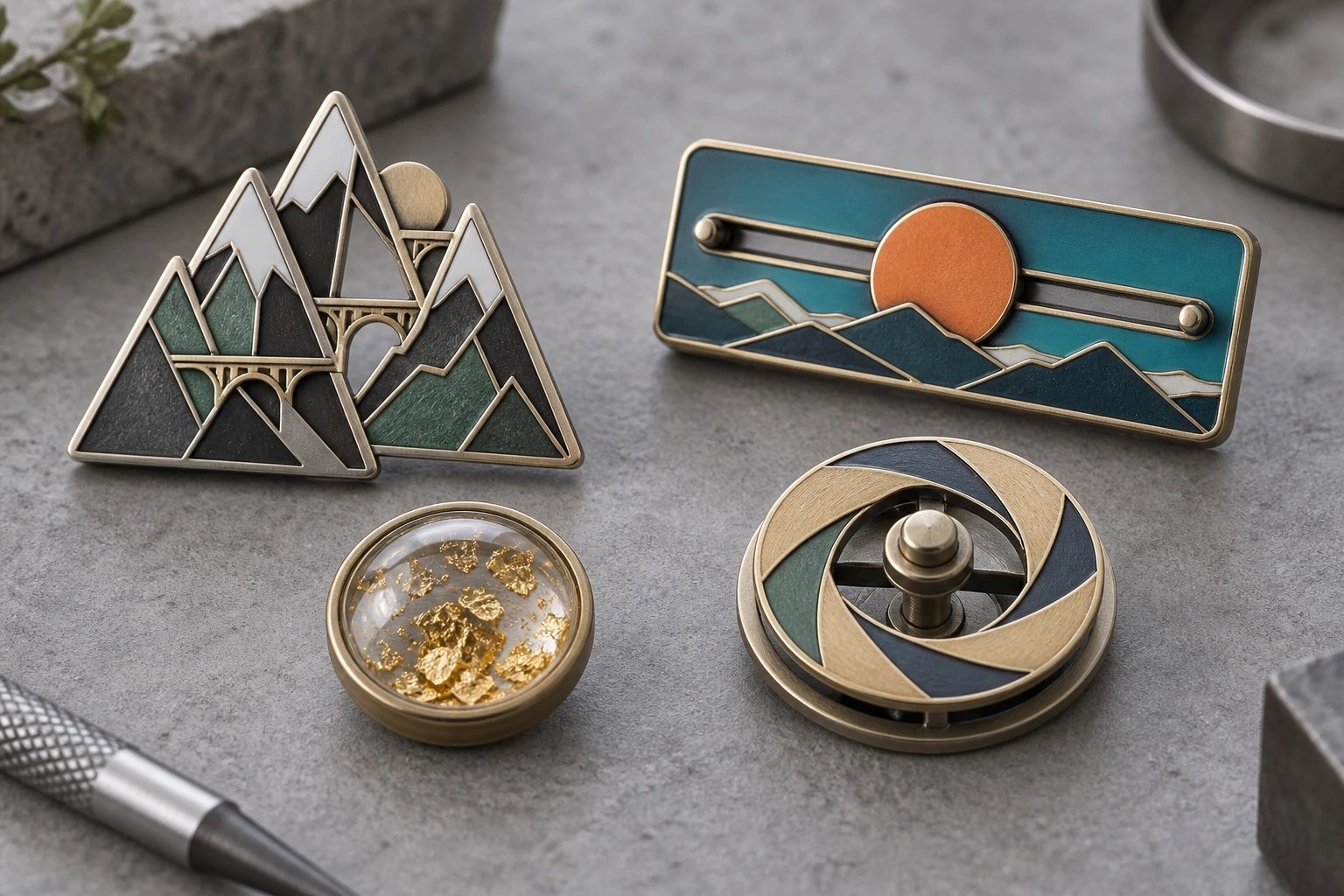
| Transparent / clear color | Semi-transparent fill over the metal | Stained-glass depth; underlying texture shows through | Pairs well with cut-outs and textured bases |

A practical rule: bold, separated color blocks suit enamel-style filling; gradients, photos and hairline detail belong to printing. If your artwork is a photograph, do not expect an enamel fill to reproduce it.
3. Surface and Plating Terms
| Term | Meaning | Typical use |
|---|---|---|
| Bright plating (gold / silver / nickel / black nickel) | Even reflective metal surface over the exposed lines | Modern branding, employee badges, clean retail look |
| Antique plating (brass / silver / gold) | Recessed areas darkened; highlights kept on raised surfaces | Vintage, commemorative, heritage themes |
| Dual or special plating | Two tone finishes, matte or rainbow effects | Trend-driven or premium custom lines |
| Epoxy dome | Clear self-leveling resin layer cured over the face | Adds gloss and helps protect printed or colored areas |
| Anti-tarnish / passivation treatment | Post-plating protection process | General handling resistance; appearance still depends on use |
A finish name is not a complete specification: bright gold, antique gold and matte gold are different products, and the final look also depends on the base metal and surface preparation. Provide a visual reference and approve a sample.

4. Decorative Effect Terms
Glitter / sequin mix – fine metallic flakes mixed into the color layer; appearance depends on particle size and lighting.
Glow-in-the-dark – light-charged pigment in selected color areas; brightness and duration depend on pigment load.
Pearl / mica paint – semi-transparent flakes for an iridescent sheen; subtle rather than dominant.
Quicksand / liquid chamber – a sealed chamber with moving decorative material; adds assembly and sealing inspection.

5. Structural and Interactive Terms
| Term | Mechanism | What to check |
|---|---|---|
| Cut-out / openwork | Areas removed to create negative space | Minimum connection widths stay strong for the product size |
| Slider | Layered rail lets one element move across the badge | Track clearance, stops, and functional inspection after packing |
| Spinning disc | A disc rotates on an axis | Axle structure and balance; movement tested before approval |
| Movable + quicksand combination | Kinetic part paired with a sealed liquid chamber | Extra assembly, sealing and leak inspection |
From Glossary to Shortlist
This page defines the terms. The effect-by-effect comparison and the step-by-step selection framework live in the metal badge processes and effects guide, which covers what each forming, coloring and finishing route produces on the finished badge and how that changes the buying decision.
Frequently Asked Questions
What is the difference between soft enamel and hard enamel terms?
Soft enamel means color sits below raised metal borders and feels textured. Hard enamel (cloisonné-style) means color is filled and ground flush with the metal for a smooth polished surface. The same artwork can read differently in the two routes, so confirm the surface level on a sample.
Can a gradient or photograph be made as an enamel badge?
Gradients, photographs and very fine detail are usually reproduced by printing under an epoxy dome rather than enamel filling, because enamel relies on separated color areas. Ask the supplier which route your artwork maps to.
What does ‘antique plating’ actually mean?
Antique finishes darken the recessed areas and keep highlights on raised surfaces, producing a vintage, dimensional contrast. Bright plating, by contrast, gives an even reflective surface. The exact look depends on the base metal and preparation, so approve it visually.
Are interactive badges more expensive than static ones?
Sliders, spinners and sealed liquid chambers add assembly, sealing and inspection steps compared with a static badge, so they usually carry more process work. Confirm the mechanism and its inspection plan before quoting.
Which process should I ask for if I only have a sketch?
Describe the desired effect, function, size and quantity. A supplier can recommend a forming and coloring route and state the assumptions in the quotation, rather than forcing every design into one method.
Use This Glossary on Your Next Quote
Bring these terms into your next RFQ so every supplier answers the same questions. For the process-selection framework behind the terms, see the custom metal badge processes and effects guide. To compare materials, finishes and commercial terms across the metal range, use the custom metal products buyer’s guide. Send artwork, dimensions, quantity and desired effect through our request-a-quote page and we will recommend a process stack based on your actual design.

READY TO START YOUR CUSTOM PROJECT?
Share your project details and artwork for a quotation. A confidentiality agreement can be signed before sampling.